MBBS in Kursk State Medical University, Russia: 2026 MBBS Admission Process, Fees, and Eligibility Criteria.
Every year a fresh batch of NEET-qualified students starts hunting for an MBBS seat abroad, and MBBS in Kursk State Medical University almost always lands on the shortlist. It is the oldest, it is government-run, and it teaches medicine in English. That combination pulls in a lot of Indian families. But popularity is not the same as the right fit, so let me walk you through what admission here actually involves in 2026, what it costs, and the parts most counselors gloss over.
Quick Facts About the MBBS Admission in Kursk State Medical University
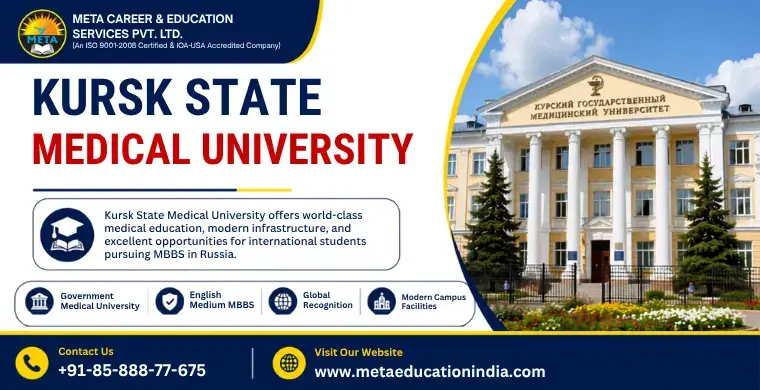
Kursk State Medical University is located in the city of Kursk, in western central Russia, roughly a couple of hours by flight from Moscow. It opened in 1935 as a medical institute and earned full university status in 1994. It was also one of the first universities in the country to run an English-medium medical course for foreign students, which is a big reason Indian enrolment here is so high. It is highly recommended for MBBS in Kursk State Medical University for Indian Students.
Detail | Information |
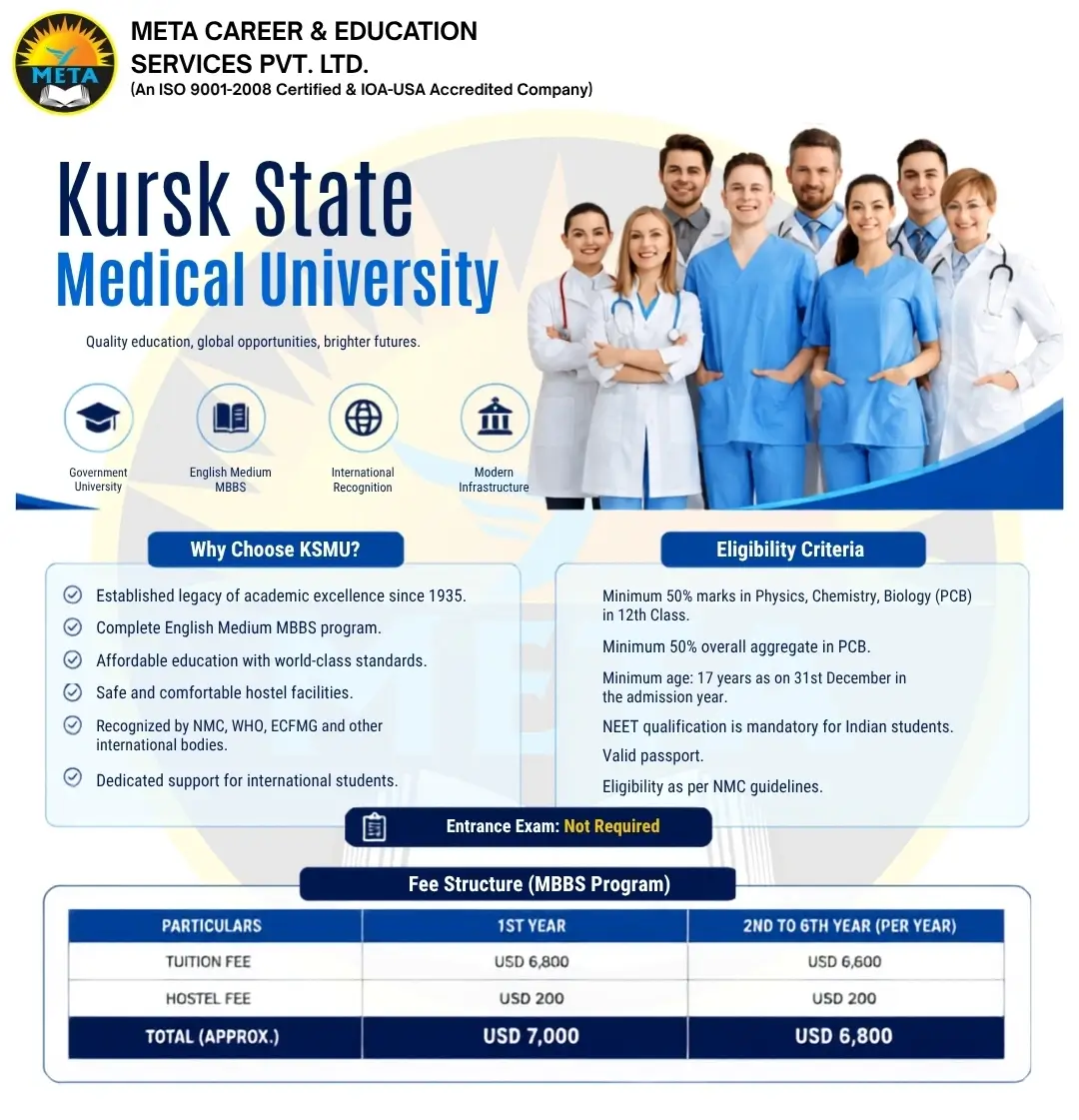
Established | 1935 (full university status in 1994) |
Location | Kursk, western Russia |
Course | General Medicine (MD physician, treated as MBBS-equivalent in India) |
Duration | 6 years (academics plus internship) |
Medium | English for international students |
Recognition | NMC and WHO listed (WDOMS) |
Intakes | September and February (Every Year) |
Indian students | Roughly 1,800 currently enrolled |
A point worth understanding early: the degree you earn is a Russian physician qualification, not literally an “MBBS.” India treats it as equivalent once you clear the licensing exam, but the name on the certificate will read differently. That trips up some families, so know it going in.
Why Students choose for MBBS in Kursk State Medical University
The honest appeal comes down to three things. The fee is far lower than a private medical college in India. MBBS Course in Kursk State Medical university is recognised worldwide, so the degree is usable back home after the licensing exam. And there is no IELTS or TOEFL requirement, which removes one hurdle for students who are strong in science but nervous about a separate English test. Kursk State Medical University Fees is more Indian friendly budget.
The university also runs a wide network of teaching hospitals across the city, so clinical exposure exists on paper. Whether you make full use of it depends heavily on you, and I will come back to that.
MBBS in Kursk State Medical University: Eligibility for Indian Students
The bar is set by the National Medical Commission, not by the university, so it is the same yardstick you would face for any recognised foreign medical school.
You need a minimum of 50 percent in Physics, Chemistry and Biology taken together in Class 12 if you are in the general category, and 40 percent if you fall under a reserved or PwD category. You must have qualified NEET, and that qualification stays valid for admission for three years. You also need to be at least 17 years old by the 31st of December in the year you take admission.
No entrance test beyond NEET applies here, and there is no language exam to clear before you join. That said, “qualified NEET” is the floor, not a comfortable margin. A bare-minimum NEET score and a casual attitude to study is exactly the profile that struggles later at the licensing stage.
Kursk State Medical University Fee for 2026
Fee Structure for 2026
Here is where you have to read carefully, because numbers float around online and many of them quietly leave out living costs. Tuition and hostel are charged in US dollars, so the rupee figure shifts every time the exchange rate moves. Treat the table below as an indicative range, not a fixed quote.
| Year / Fees Structure | Tuition Fee + MI | Hostel Fee | Total Fees |
|---|---|---|---|
| First Year | 4,35,798 Ruble | 54,670 Ruble | 4,90,468 Ruble |
| Second Year | 4,29,550 Ruble | 54,670 Ruble | 4,84,220 Ruble |
| Third Year | 4,29,550 Ruble | 54,670 Ruble | 4,84,220 Ruble |
| Fourth Year | 4,29,550 Ruble | 54,670 Ruble | 4,84,220 Ruble |
| Fifth Year | 4,29,550 Ruble | 54,670 Ruble | 4,84,220 Ruble |
| Sixth Year | 4,29,550 Ruble | 54,670 Ruble | 4,84,220 Ruble |
| MBBS in Russia – Tuition Fees and Hostel Charges for 6 Years Approx. | 29,11,568 Ruble | ||
| Food Charges (Per Month) | 6,248 – 7,810 Ruble | ||
| Other Charges | 1,17,150 Ruble | ||
Add it up across six years and the realistic all-in budget lands somewhere between 38 to 44 lakh rupees, depending on how the rubble and dollar behave and how you live. Kursk State Medical University Fees alone is the smaller part of that picture. The food, travel, insurance and yearly fee increases are what push the real total up, and those are precisely the heads that get left out of a glossy “package” figure.
Two more things to keep in mind. Kursk State Medical University fees tend to rise a little each year due to an increase in rubble cost, so do not assume year one’s number holds for all six. And if anyone quotes you a single neat lifetime figure that sounds suspiciously round, ask exactly what it includes and what it excludes in writing. If you want to compare fees across multiple universities before making your final decision, check our complete Cost of MBBS in Russia breakdown available on our MBBS in Russia page.
MBBS in Kursk State Medical University: A Complete Admission Process Works
The process is genuinely simple, which is part of admission formalities. You begin by sending scanned copies of your Class 12 marksheet, passport, and NEET result. A representative of the university reviews these and issues an admission letter, usually within a couple of days. Once that is confirmed, the university sends an official invitation letter, which is the document you need to start your student visa application in India.
With the invitation letter and your fee payment receipt in hand, you apply for the Russian student visa through the embassy. After the visa comes through, you arrange travel, typically timed so students from the same region fly together. The full cycle for the September intake usually runs through the spring and summer months, so starting early matters if you want the autumn batch. After completion of all formalities, Company will do all departure formalities for MBBS Admission in Kursk State Medical University.
Intakes and Timeline
MBBS Course in Kursk State Medical University provides two intakes each year. The September intake is the main one and takes the larger share of students. A second intake opens around February for those who miss the autumn window. If you are aiming for September, having your documents and visa sorted by mid-summer keeps you comfortable rather than scrambling. Each Intake Kursk State Medical University MBBS fees may be changes due to Ruble cost changes.
The Part Most People Skip: Coming Back to Practise
This is the section that decides whether the whole plan works, so do not skim it.
A foreign medical degree does not let you practise in India on its own. You have to clear a licensing exam first. Right now that exam is the FMGE, and for anyone graduating in or around 2026 it remains the exam that counts. The National Exit Test, or NExT, has been talked about for years as the replacement, but the NMC deferred it again and is running mock tests through a multi-year pilot before any real rollout. The practical takeaway: you will face a licensing exam at the end, it is FMGE today, and the format may shift to NExT by the time today’s first-years actually graduate around the early 2030s. Plan for the exam, not for a loophole.
Now the uncomfortable number. The overall FMGE pass rate for graduates from Russian universities has historically sat low, in the rough range of a quarter to a third of candidates clearing on a given attempt, and it swings noticeably between sessions and between universities. That is not a Kursk-specific verdict, and a reliable published pass rate tied to this one university is not something I would quote you from a brochure. Before you commit, ask directly for the university’s recent FMGE numbers and cross-check them against the official NBEMS performance reports rather than trusting a marketing line.
Why do so many capable students stumble at this stage? A few honest reasons. The Russian curriculum does not map neatly onto the FMGE syllabus, especially around the diseases and clinical patterns common in India. Clinical years often need working Russian to actually talk to patients, and students who never pick up the language end up watching rather than doing. And most universities, Kursk included, do not hand you tailored FMGE coaching, so the preparation burden falls on you and ideally starts in your third year, not after you fly home.
None of this means avoid Russia. It means go in with your eyes open, pick study habits early, learn enough Russian to be useful on the wards, and treat the licensing exam as the real finish line from day one.
Hostel and Living
KSMU Russia Fees, The university provides hostel accommodation on a sharing basis, with furnished rooms and the usual kitchen, laundry and study facilities. Indian mess options exist in most student areas, often at an additional monthly cost. KSMU MBBS Fees is a mid-sized, reasonably safe city, and living expenses are modest by European standards, which is a genuine plus for a six-year stay.
Conclusion
Kursk State Medical University is a legitimate, recognised, affordable route into medicine for a student who is realistic about the work involved. The admission process is easy and the fee is friendly. The hard part is not getting in; it is coming back as a licensed doctor. Choose it because you have weighed the licensing reality and decided you will put in the years of disciplined study it demands, not because the brochure made it sound effortless. Do that, and Russia can absolutely work for you.
Frequently Asked Questions
Yes. It is listed in the World Directory of Medical Schools and recognised by the NMC, which is the baseline you need for the degree to count in India.
For Indian students, yes. Even where the university itself might admit you without it, you cannot get the eligibility certificate or sit the Indian licensing exam later without a valid NEET qualification.
Budget realistically for 30 to 40 lakh rupees across six years once tuition, hostel, food and living are all counted. The exact figure moves with the exchange rate.
You earn a Russian physician qualification that India treats as MBBS-equivalent after you clear the licensing exam. The certificate wording differs from an Indian MBBS.
Classes are in English, but you will need functional Russian during clinical years to interact with patients. Starting the language early makes those years far more useful.
FMGE for now. NExT is deferred and in a pilot phase, so today’s entrants should prepare for FMGE while watching for any shift to NExT before they graduate.