
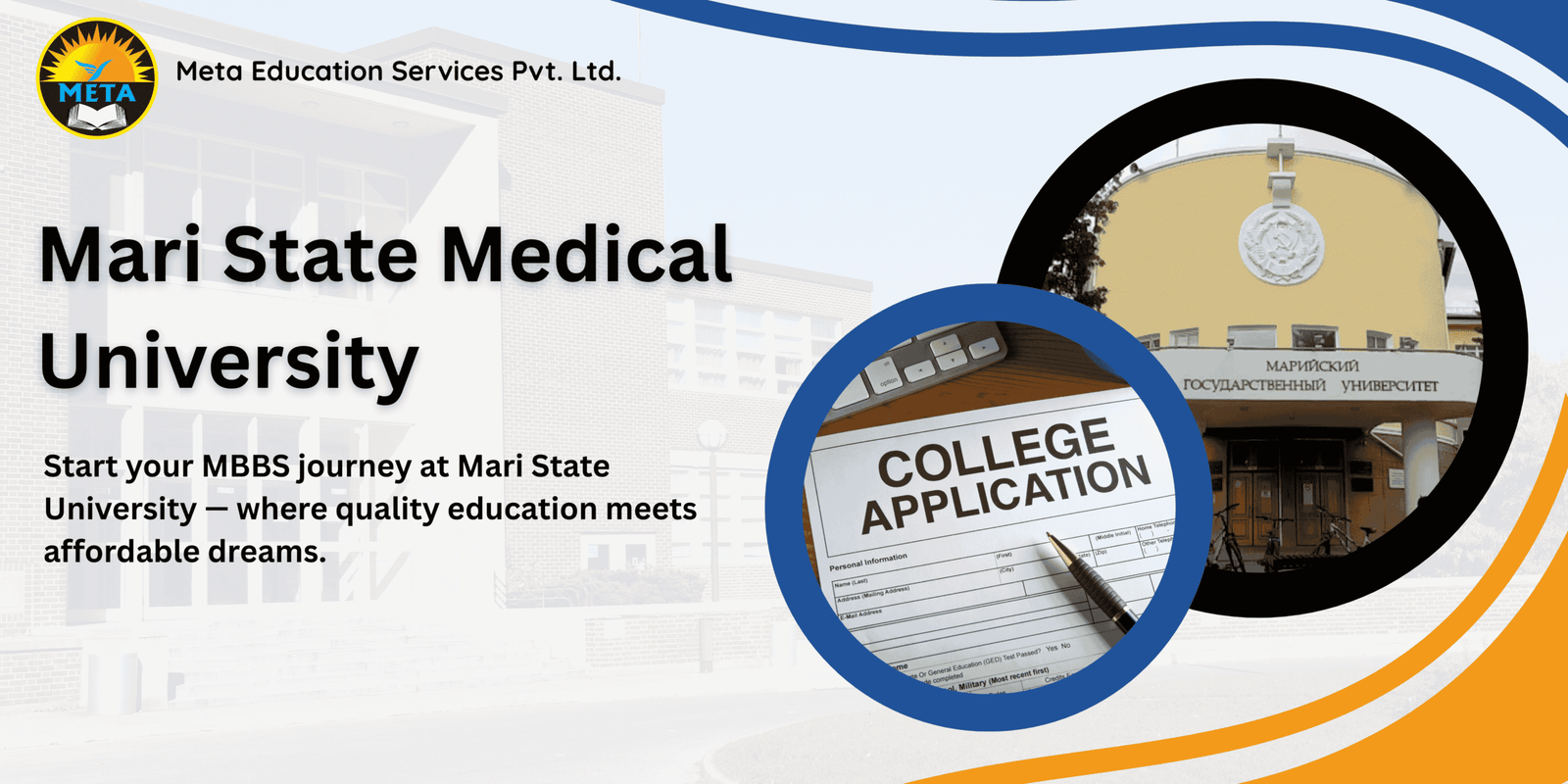
Mari State Medical University: An Honest Guide for Indian Students Considering MBBS Here in 2026
Let me ask you something.
When you started looking at MBBS in Russia, how many universities did you find? Forty? Fifty? More? It’s overwhelming, I know. Everyone claims to be the best. Every consultancy has a different “top three”. And somewhere in all that noise, names like Mari State Medical University get filed away as just another Russian option. That’s a mistake. And I’ll tell you why.
Mari State University has been quietly training doctors since 1972. Over fifty years. Right now, around 1,500 Indian students are studying medicine on its campus. That’s not a marketing claim — that’s a community. And these students didn’t end up at MarSU because nothing else worked out.
They picked it because the math made sense. Here’s the honest breakdown of what Mari State University actually offers, what it costs, and whether it deserves a spot on your 2026 shortlist.
What Mari State Medical University Actually Is
Mari State Medical University sits in Yoshkar-Ola, the capital of the Mari El Republic in central Russia. The city is about 645 km east of Moscow — close enough to feel connected, far enough to be affordable. Kazan International Airport is roughly 150 km away, which is your usual entry point from India.
The university itself spans around 128,000 square metres. Seven academic buildings. Eight hostel buildings. About 9,000 students total, with 2,800+ international students from 47 countries. The faculty is genuinely deep — over 570 lecturers, 3,000 doctors and professors, and 1,200 candidates of science.
Now here’s the thing nobody mentions in brochures. Back in 2009, MarSU got the gold medal under “European Quality:100 Best Universities of the Russian Federation.” That’s not a marketing award. That’s actual institutional recognition.
The university is approved by everyone you’d want it approved by — NMC, WHO, WDOMS, ECFMG, FAIMER, UNESCO, plus the medical councils of Canada, Australia, the UK, and several others. Translation: an MBBS Admission in Russia from Mari State University works in India, the US, Canada, Australia, the UK, and most of Europe — provided you clear the respective licensing exams.
Why Indian Students Genuinely Pick Mari State University
Three real reasons. Not the brochure version — the actual reasons.
Reason one: The fees make sense. Mari State Medical University fees are around USD 6,000 per year, often including hostel. Total course cost across six years lands roughly ₹30-33 lakh. Compare that to private MBBS in Bangalore at ₹1.2 crore, or even mid-tier private colleges in UP at ₹70 lakh, and the value picture becomes obvious.
Reason two: English medium, no language test drama. The entire MBBS programme is taught in English. Russian is taught alongside, mainly for clinical communication during hospital rotations. No IELTS. No TOEFL. Your Class 12 English-medium qualification is enough.
Reason three: The Indian student infrastructure is real. With 1,500+ Indian students already there, MarSU has built genuine community-level support. Separate Indian housing blocks. Indian mess facilities with both veg and non-veg options.
FMGE coaching support during final years.
Senior-junior mentoring networks that actually function. This last point matters more than people give it credit for. Studying medicine abroad is hard enough without battling food, language, and isolation problems alone.
MBBS in Mari State University: Eligibility Criteria for India Students
The eligibility setup is straightforward, but pay attention because small mistakes cost admissions. Class 12 background. You need PCB plus English. Physics, chemistry, biology—the standard medical entry combination. Biotechnology can substitute for biology in some boards, but mathematics cannot. Commerce or arts students don’t qualify.
Minimum marks needed:
- General/EWS: 50% in PCB
- SC/ST/OBC: 40% in PCB
- PwD General: 45% in PCB
These percentages are calculated on PCB only — not your overall Class 12 percentage. Common mistake. NEET UG qualification is non-negotiable. Yes, even for MBBS in Russia. Without a valid NEET scorecard at the qualifying percentile (50th General, 40th reserved), your degree won’t be recognised by NMC for medical practice in India. Doesn’t matter how good the university is.
NEET UG score is the wall. Age requirement: At least 17 years old by December 31 of the admission year. No upper age limit — the NMC removed that years ago. English proficiency tests: Not required. Your Indian English-medium qualification is accepted. Medical fitness: Standard fitness certificate plus an HIV-negative test report.
MBBS Admission in Mari State Medical University Required Documents
| Students have to complete the age of 17 years on or before 31st December of this year in order to apply for the particular year for MBBS in mari state university for Indian Students & MBBS admission in mari state medical university Fees. |
| Filled up University application form |
| 10th Mark sheet |
| 12th Mark sheet and certificate |
| Qualified NEET Score Qualified 2024, 2025 & 2026 ( NEET Exam will be by May 2026) are accepted. |
| Copy of passport |
| Digital photograph |
Note: It is based on university admission criteria. Each university has its own percentage requirement for admission terms and conditions apply
Mari State Medical University Fees — The Real Numbers for 2026
Forget the inflated agent estimates. Here’s what families actually end up spending. In Mari State Medical University MBBS fees:
Tuition fee structure:
- First-year fee: Around USD 6,000 (₹5-5.3 lakh) — usually includes hostel
- Years 2-6 tuition: Around USD 5,000-6,000 per year (₹4.5-5.3 lakh)
- Total 6-year tuition: Roughly USD 35,000-38,000 (₹30-33 lakh)
Beyond tuition — the things people forget:
- Hostel charges (years 2-6 separately): ₹40,000-60,000 annually
- Food and personal expenses: ₹10,000-15,000 a month, so ₹1.2-1.8 lakh annually
- Health insurance: ₹15,000-25,000 a year (Russia mandates it)
- Visa, registration, document legalisation: ₹15,000-20,000 one-time
- India-Russia round trip flights: Budget ₹40,000-60,000 each year
Realistic total for the full Mari State Medical University MBBS Fees: roughly ₹38-45 lakh when you load tuition, hostel, food, insurance, and travel honestly.
A few things you absolutely need to know about fees:
There are no donation charges. None. The university doesn’t collect capitation. No entrance exam fee either.
You pay tuition directly to the university’s official bank account. Always. Never wire money to an agent’s personal account, no matter what they tell you about “processing convenience” That’s how scams happen, and they happen every year in this corridor. Annual instalments are accepted, so families don’t deposit everything upfront. That helps with planning.
What the MBBS in Mari State University Actually Looks Like
Six years total. That’s the structure.
Years 1-2 are pre-clinical. Anatomy, Physiology, Biochemistry, Histology, Embryology — the foundational stuff every doctor must master. Latin is also taught early, which sounds odd but matters for medical terminology.
Years 3-4 are para-clinical with early clinical exposure. Pathology, Pharmacology, Microbiology, Forensic Medicine, plus first patient interactions at affiliated hospitals.
Years 5-6 are full clinical. Internal Medicine, General Surgery, Paediatrics, OBG, Psychiatry, Dermatology, ENT, Ophthalmology, Emergency Medicine. The final 1.5 years are spent in proper clinical rotations and the rotating internship.
Infrastructure-wise, the university has 100+ laboratories and scientific centres, modern simulation training facilities with mannequins for hands-on practice, 100+ practical training bases at affiliated hospitals across the region, and a digital library with over 1.1 million books.
What does this mean practically? You’re not stuck in textbook mode for years before seeing patients. You touch real clinical work fairly early, which makes the difference between graduating as a confident clinician versus someone who can pass exams but fumbles real cases.
Hostel, Food, and Daily Life — The Real Picture
Around 2,500 students live in MarSU hostels. Rooms are typically 2-3 sharing. Indian students often get assigned to dedicated Indian housing blocks with cultural-specific support.
What hostels actually offer:
24/7 security with hostel wardens who actually respond when needed. Centralised heating, which trust me, you’ll appreciate during Russian winters. Reliable Wi-Fi. Common kitchens for self-cooking. Laundry. Study rooms. Recreation areas. Indian food situation. The university mess specifically prepares Indian dishes — both veg and non-veg. Outside campus, Yoshkar-Ola has Indian restaurants and grocery shops because of the established Indian student community.
You won’t be eating borscht every day unless you want to. Climate honesty. Yoshkar-Ola has a continental climate. Winters from November to March hit -10°C to -25°C with snowfall. Cold, but not Siberian-extreme. Summers are mild, around 20-25°C, genuinely pleasant. Pack accordingly. Buy the heavy winter gear after arriving — it’s better quality and cheaper in Russia than what you’d buy in India.
What Happens After You Graduate in Mari State Medical university
Three honest paths.
Come back to India. Clear FMGE or NExT under the new NMC framework. Complete a one-year Indian internship. Register with your State Medical Council. Start practice or prep for NEET-PG. MarSU runs on-campus FMGE coaching during the final years, which
actually helps.
Go international. USMLE for the United States. PLAB for the UK. AMC for Australia. Plus licensing options in Canada, Germany, the UAE, and most of Europe. Mari State University’s ECFMG certification and WDOMS listing keep these doors open.
Postgraduate specialisation. Either continue PG studies in Russia, return to India for NEET- PG, or pursue international PG based on your licensing route.
Final Word
Mari State University is a genuine option. Not the cheapest in Russia, not the most prestigious, but probably the best value-to-credibility ratio you’ll find for English-medium MBBS abroad in 2026. If MarSU is on your shortlist, do these three things this month. Verify NMC approval directly on the official NMC portal — not from a consultancy website.
Get your document legalisation started by April 2026 — Russian embassy paperwork doesn’t accommodate last-minute panic. Talk to current Mari State University students through Indian student groups on Facebook, WhatsApp, or Instagram. Their unfiltered feedback is more useful than any consultancy testimonial.
The September 2026 intake is closer than it looks. Start your verification today, plan your finances honestly, and walk into your medical career at an MBBS in Mari State University, that’s been training doctors longer than half the medical colleges in India have existed. Don’t overthink it. Just do the work.